By Rev. Steven M. Avella
Catholics draw their missionary inspiration from Jesus’ instruction in Matthew 28:19: “Go, therefore and make disciples of all nations…” These words have inspired countless men and women to abandon the comfort of their homes and families and to travel the globe to proclaim the Good News of Christ’s Resurrection.
Christianity spread from Palestine both east and west. Using the roads of the Roman Empire (and the safety and security that the Roman legions and navy provided on land and sea), early disciples of Jesus traveled to many of the great cities creating local churches. Rome, the capital of the empire and the site of the martyrdom of SS. Peter and Paul became an important center point. These churches evolved in structure and organization to create the Christian Church. In the west, it eventually became unified under the leadership of the Bishop of Rome, later referred to as the pope.
Theological and organizational evolution led to the formation of religious orders of men and women who proclaimed the gospel in new lands and cultures. Christianity demonstrated a talent for adapting to local conditions and languages, often building on the religious sensibilities of the people they sought to evangelize. Using Roman administrative tools, the world was divided up into territorial units known as dioceses, presided over by bishops.
The era of discovery and encounter (1492-1600) opened North and South America and the Caribbean to Christian evangelical efforts. Priests of different religious orders, Franciscans, Dominicans, and Jesuits, came to North America to convert native peoples to Christianity. These encounters were often mutually beneficial, with missionaries learning the languages of native peoples, their folkways, and their social structure. Many native people accepted whole or in part some of the lessons the missionaries came to bring. Others rejected Christianity. Many native peoples died of diseases brought over by European soldiers and colonists. France, England, and Spain were the main claimants to North American territories. Extracting wealth from the North American frontier (furs and other peltry) became a primary economic motivator for French penetration of the North American interior.
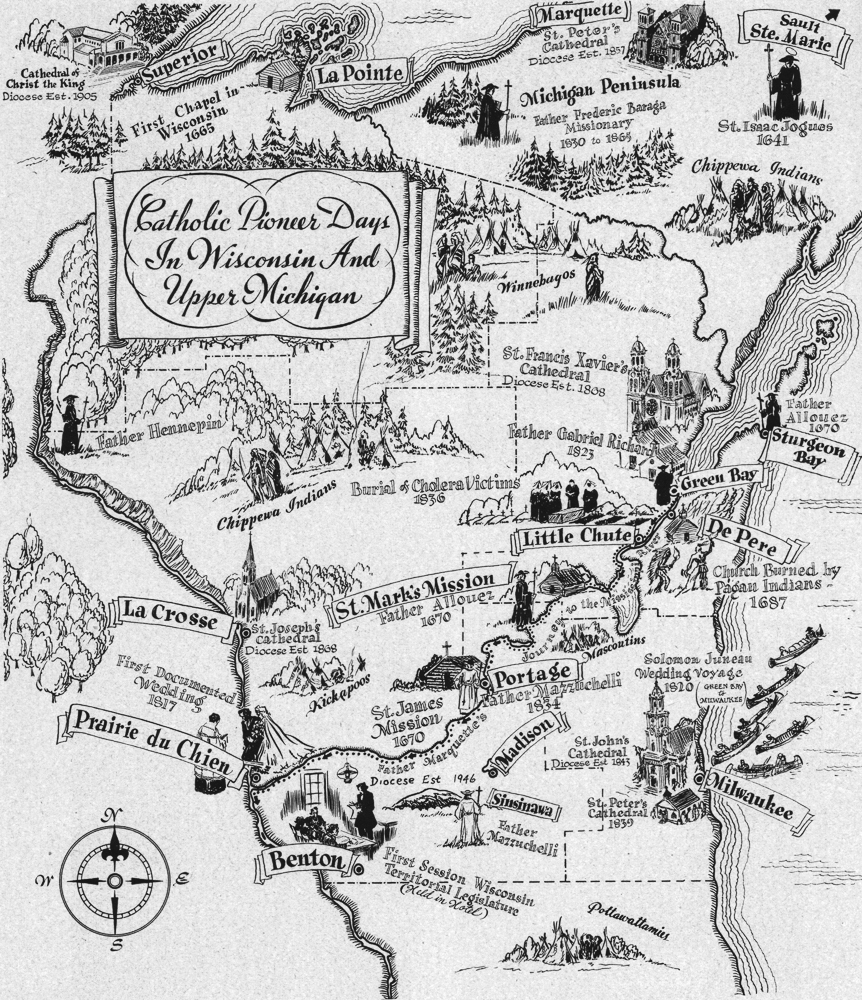
New France had control over the area that later became Wisconsin. Other priests worked here, but the French Jesuits took the lead. Father Rene Menard, S.J. is thought to have been the first Catholic cleric in Wisconsin (1661). Other Jesuit missionaries included Claude Allouez, Claude Dablon, and perhaps the most famous, Jacques Marquette (1637-1675). These men plied the inland waters of Wisconsin, launching out from mission stations on the upper peninsula of Michigan to form mission stations in Green Bay and Prairie Du Chien. Encountering the native peoples produced some conversions, although it difficult to ascertain how many remained Catholic.
Internal church politics temporarily ended the Jesuit missionary enterprise (the Order was suppressed from 1765-1815). Among Wisconsin’s small population were only a handful of white settlers and native peoples who sustained their Catholic faith by home devotions. From 1781-1820, apart from the occasional itinerant, there were no priests in Wisconsin to offer Mass or hear confessions.
The Catholic Church came back to life in Wisconsin after the American Revolution, when the area passed into the hands of the new United States. Wisconsin was part of the territory known as the Old Northwest. The U.S. government regulated and integrated undeveloped lands into the new nation and allowed the surveying and sale of Western lands. In the 1830s, settlers begin to make their way to Wisconsin. By 1848, it became a state of the Union.
/https://archmil.hghlnd.com/HISTORY/Part-1/Marquette-painting-for-website.jpg)