Health Care
Even before the advent of modern scientific medicine, the Church sponsored institutions for the care of the sick and dying. Religious communities of men (Alexian Brothers and Camillans) offered these services, as did religious communities of women including the Sisters of Mercy and the Daughters of Charity. A great inspiration was St. Vincent de Paul.
An early form of health care in the archdiocese was home nursing provided by the Salvatorian Sisters and the Wheaton Franciscans.
Virtually every city in the archdiocese had a Catholic hospital, including:
- St. Mary’s Hospital, founded by the Daughters of Charity, first as St. John’s Infirmary; moved to the north side of the city in 1858 and was renamed St. Mary’s Hospital. The Daughters of Charity also provided medical care for people on Jones Island.
- St. Joseph Hospital-Milwaukee, founded in 1879 by the Wheaton Franciscans.
- St. Mary’s Hospital, Racine, founded in 1882 by the Wheaton Franciscans.
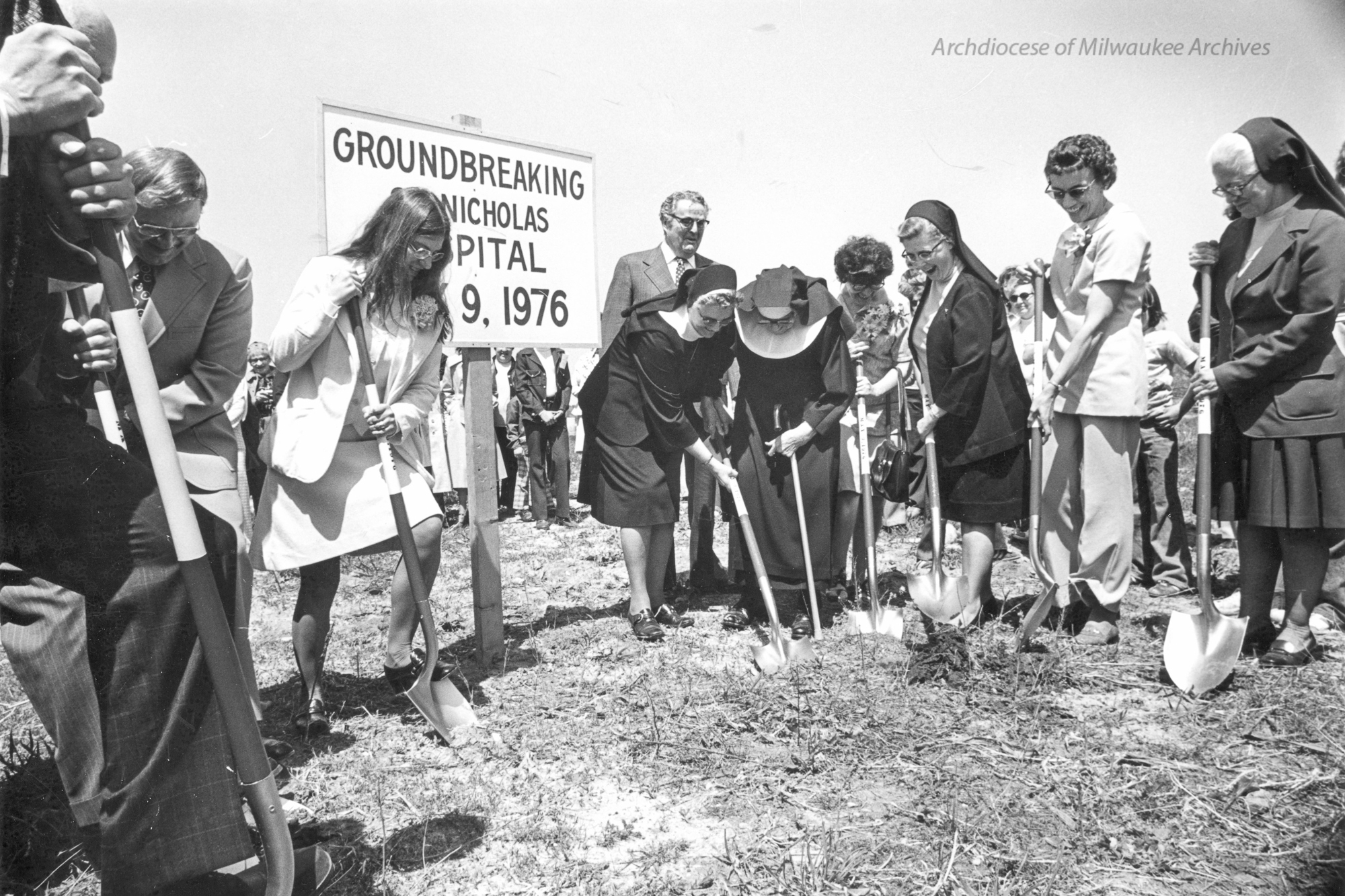
- St. Nicholas Hospital, Sheboygan, founded in 1890 by the Hospitaller Sisters of Third Order of St. Francis.
- Sacred Heart Sanitarium, Milwaukee, founded in 1893 by the School Sisters of St. Francis.
- St. Agnes Sanitarium, Fond du Lac, founded in 1896 by the Sisters of St. Agnes; renamed St. Agnes Hospital in 1900.
- St. Mary Hill Hospital, Milwaukee, founded in 1912 by the School Sisters of St. Francis.
- Misericordia/Elmbrook Hospital, founded in 1908 by the Sisters of Misericordia as home for unwed mothers; evolved into a hospital in the 1960s.
- St. Catherine’s Hospital, Kenosha, founded in1917 by the Dominican Sisters of St. Catherine of Siena.
- St. Camillus Hospital, Milwaukee, founded in 1921 by the Order of St. Camillus.
- St. Joseph Hospital, Hartford, founded in 1927 by the Religious Hospitalers of St. Joseph.
- St. Anthony Hospital, Milwaukee, founded in 1930 by the Capuchins and Franciscan Sisters of Little Falls.
- St. Joseph Hospital, West Bend, founded in 1930 by the Sisters of the Divine Savior.
- St. Joseph Hospital, Beaver Dam, founded in 1936 by the School Sisters of St. Francis.
- St. Michael Hospital-Milwaukee, founded in 1941 by the Wheaton Franciscans.
- St. Alphonsus Hospital, Port Washington, founded in 1941 by the Sisters of the Sorrowful Mother.
- St. Francis Hospital, Milwaukee, founded in 1956 by the Felician Sisters.
- St. Joseph, Waupun, founded in 1947 by the School Sisters of St. Francis.
- Trinity Hospital, Cudahy, founded in 1958 by the Franciscan Sisters of Great Falls.
Character of Hospital Care
Catholic health care stressed the importance of prayer and sacraments in the healing process. Hospitals had priest chaplains, chapels, crucifixes, and religious statuary. Many of the sisters were nurses and attended patients wearing their habits.
Hospital care changed over the years. Between 1870 and 1940, hospitals “shift from a place of charitable care to a modern technological machine for all patients.” (Barbara Mann Wall). Medical knowledge expanded and improved with the acceptance of bacteriology, antiseptic methods, and other medical advances including technologic innovations such as x-rays.
The American Medical Association, the American College of Surgeons and Physicians, and other professional societies improved standards for doctors and nurses. Changes in hospital architecture standards paved the way for new wards, more air and sunlight (solariums), nursing stations, laboratories, and educational facilities. Most hospitals expanded.
The Catholic Hospital Association (today the Catholic Health Association of the United States) was formed in 1915 and was first located in Milwaukee. It provided guidelines and encouragement for Catholic health care providers.
Schools of nursing were attached to major hospitals and nurse’s training became more rigorous and demanding.
The aftermath of World War II brought new pressures for additional changes in health care. Population shifts required new hospitals and care facilities in suburbs. Existing hospitals needed upgrading and expanding. There were efforts at national health insurance. Congress passed the Hill Burton Act in 1946, providing grants for hospital construction.

/https://archmil.hghlnd.com/HISTORY/Part-9/Social-Provision-history.jpg)